Haßfurt Sliding Net
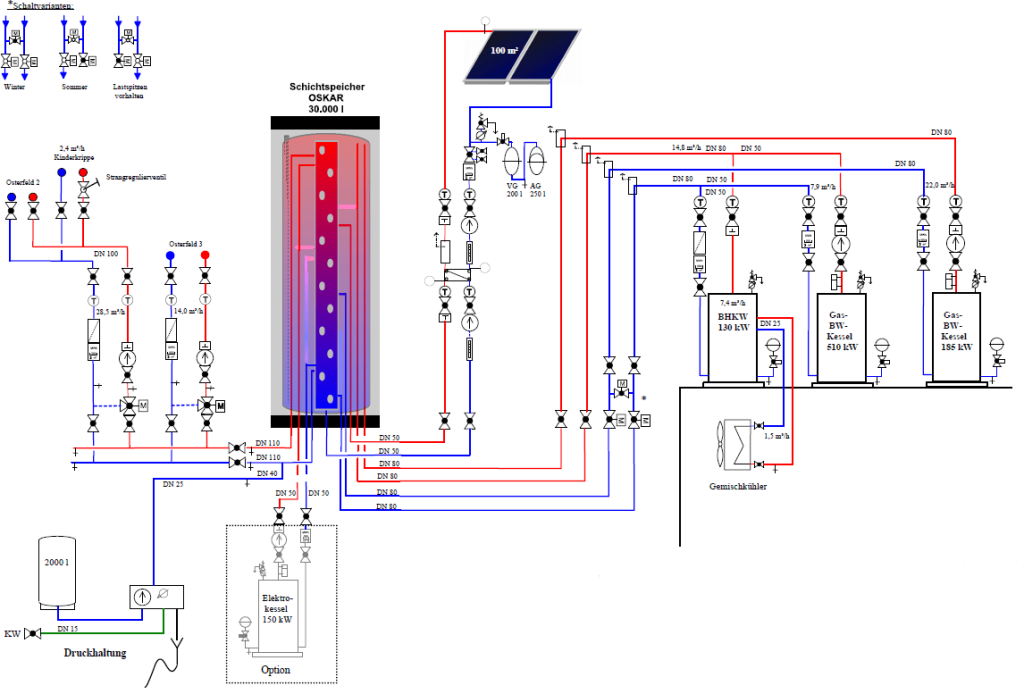
As part of its urban development plans, the city of Haßfurt planned the Am Osterfeld II development area with local heating from the outset. The municipal utilities are thus pursuing a consistent policy of supplying the city with decentralized energy from renewable sources. Due to the high insulation standard of the buildings in the new development area and the associated low power density in the local heating network, it was decided to design the network as a sliding, cold network.

Successful combination model
The heating network is supplied entirely by a heating plant using renewable energy, which is equipped with a combination of a bio natural gas CHP unit and a solar thermal system. During the summer months (April-October), solar thermal energy can contribute a large proportion of the energy generated, with the flow temperature in the network fluctuating between 15-25°C during this period. The target temperature required for heating and hot water supply is achieved through the use of decentralized heat pump transfer stations in the homes of the connected participants.
During the winter months, the CHP plant generates heat directly and the network is operated at a maximum flow temperature of 60-65°C. The entire network is monitored and controlled by means of an artificial neural network that collects the necessary measurement data. The SiMon energy management software, adapted to the specifications of the municipal utilities, monitors and coordinates the entire system. The artificial intelligence integrated into the software allows SiMon to evaluate the weather forecast, compare it with the results of the analysis of consumer behavior, and select the most resource-efficient generation strategy.