
Power conversion for greater efficiency
The term “Power-to-Heat” or “Power-2-Heat,” abbreviated as p2h or PtH, refers to the conversion of renewable electricity generated from sources such as photovoltaics (PV), wind energy, or biogas into heat. This heat can be stored very easily and in an environmentally friendly manner in large heat storage tanks—unlike complicated battery storage systems. This energy storage system has been tried and tested for many decades. Currently, many PV systems in private households and other buildings are facing the decision of what to do with the electricity generated by the PV system once the EEG feed-in tariff expires. Many of the systems installed in private households still work perfectly, so dismantling them does not make sense. ratiotherm offers intelligent solutions for dealing with such surplus renewable electricity efficiently and intelligently.

The advantages of power-to-heat at a glance:
See for yourself:
Our proven products in this sector
The possible variants of Power-2-Heat in single-family homes:
P2H originally comes from larger plant engineering and is now widely used in the bioenergy sector (biogas, wind), partly in the field of control energy. Energy suppliers use such systems to stabilize the power grids at times of oversupply. In private households and smaller commercial buildings, two types of Power 2 Heat applications are particularly prevalent:
Power-to-heat with heating element:
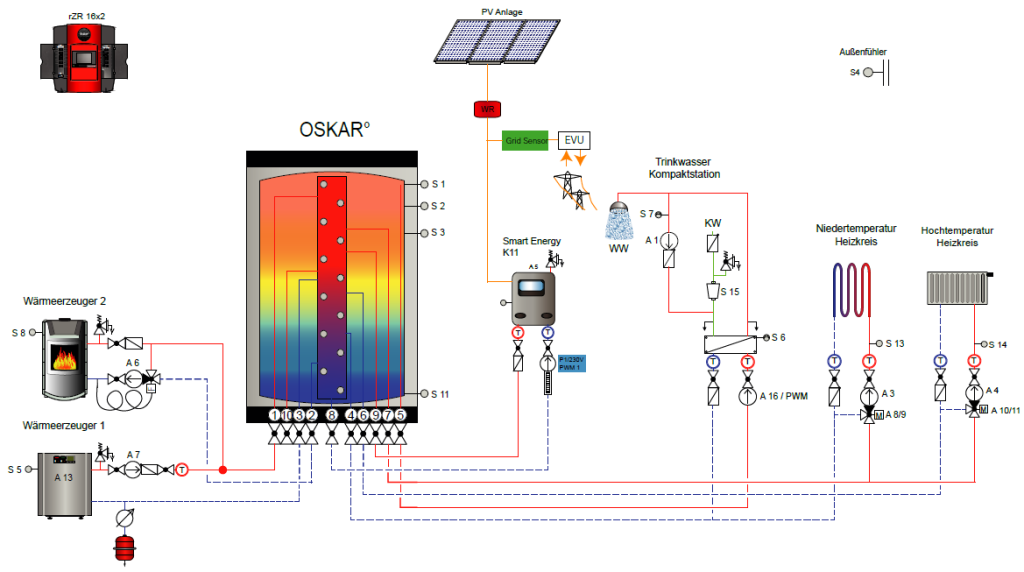
The simplest way to use surplus electricity from photovoltaics to heat your own building is with a heating element. Most systems are installed in existing buffer storage tanks as a screw-in solution and, depending on the technology, they operate in cycles or, in some cases, in a modulating manner.
The major disadvantage here is that the heat is introduced into the lower part of the heat storage tank. This causes the contents of the tank to mix, which reduces the amount of heat available to the consumer. This is because the colder layers further down in the buffer tank are heated by the heating element due to the difference in density of water at different temperatures (see also the operating principle of Oskar° stratified storage tanks).
Based on our experience with stratified storage technology, we have given this topic a great deal of thought and are therefore offering our Smart Energy PV as the optimal solution for the p2h photovoltaic market. This system operates externally—i.e., not built into the storage tank—and therefore has no problems with storage tank mixing. The user has immediate access to heat at a defined temperature level.
Power-to-heat with heat pump:
A very efficient way of using Power-2-Heat in single-family homes is to combine PV electricity with a heat pump.
It does not matter whether it is an air source heat pump or a ground source heat pump. However, the heat pump must have the appropriate contacts or signal inputs and the associated control system to communicate with the inverter, smart meter, or energy management system. Heat pump systems with speed control, known as inverters, are particularly suitable. This technology allows the system to operate at reduced power (i.e., reduced speed) even when solar radiation is not so intense, thus enabling the maximum amount of PV electricity to be used in the heat pump.
ratiotherm offers only heat pumps that can communicate with PV systems, and all heat pumps are equipped with inverter technology as standard. Our WP Max-Air air source heat pump can even provide active cooling during the summer months using PV power if required.


Possible uses and areas of application for the p2h Max Heater device
Variations in use:
- Excess electricity as own consumption for hot water production
- Use of surplus electricity from inverters capped by the energy supply company to optimize the 70% rule.
- Combination of battery storage and Max Heater
- Connection of additional consumers via radio-based applications possible
- Can also be used as a sole heat generator, for example in vacation homes or other buildings that are only used occasionally.
- Further variations are possible at any time by our programmers by adjusting Max Heater according to customer specifications.
Areas of application
- In private households, for heating drinking water in summer and, in some cases, for supplementary heating in winter.
- In the field of agriculture, for the provision of process heat (cleaning milking systems, etc.), but also for heating support, because there are many very large PV systems here that also supply usable amounts of electricity in winter or in bad weather.
- In the commercial sector, p2h can easily cover the often low demand for drinking water, especially since large roof areas (halls, etc.) are often covered with PV systems and the necessary power is available.
- Alternative Nahwärmenetze, sogenannte Kalte Nahwärmenetze können zur Unterstützung der vorhandenen Energieerzeuger mit Power-2-Heat Systemen auf Basis von Wärmepumpen oder Elektroheizstäben ausgestattet werden

